Friday, March 4, 2011

The eyes of a hungry child: Is there or isn't there oil in Kenya?

The eyes of a hungry child
By Philo Ikonya
- Is there or isn’t there oil in Kenya?

In memory of J. M. Kariuki, 2th March 1975.


Who among our politicians today can be interested to the point of obsession with the ‘eyes of a hungry child?’ like J. M. Kariuki was in his days? Who? Who cries in the same breath for Pokot, Kiambu and Shimo la Tewa, as he did? He represented the peoples' voice in Parliament, he was it.. who is there today for our voice?


We daily follow what politicians are planning and saying in Kenya but they do not reciprocate our interest by leading people to more consciousness, a deeper level. What am I talking about?
I feel those who are powerful through our votes in Kenya do not exercise their power and use the platforms we give them to make us into a nation.We should never have expected them to do that. We have to do it ourselves. But we have to make this work easier by electing people who act upon what we voice and also voice it themselves. People whose minds even go beyond our own thinking, people with foresight. We are tired of the ones who cannot even with the benefit of hindsight see how important it is that Kenya becomes more cohesive by means of zeor tolerance of corruption and impunity.

Those we have today are unable to help unite our nation against things that others have conquered on our continent and in which we should be the giants to watch. We have to spend so much time on tribalism, police brutality and harassment, the Hague, makeshift parties to deliver votes for tomorrow that we forget the urgency with which the sick in Kenya need medical improvements.

We forget to start challenging the making of the budget to be read in June today. Now with the crisis in the North how will the cost of paraffin be affected in Kenya? Why has this government dragged its feet on the prospection of oil in Kenya using Chinese firms rather than the more efficient Canadians who have sealed their deals in Uganda and Ghana?

If we discover oil in Kenya will we grow like Ghana or become a Nigeria? Will the oil be used as in Norway to benefit all the people or be grabbed as are minerals found in Kenya also by politically connected individuals.

The East African newspaper exposed this and challenged  your poor work at finding oil in 2008/2009. Today The Economist tells us that African countries: Ghana, Uganda, Rwanda, Kenya and others are forecast to improve their growth to higher digits in 2011, with Ghana reaching double digits provided our politics improved. This is what has failed Kenya for so long. http://www.economist.com/node/17493372
Yet Kenya was poised to improve based upon her agriculture. Are we serious about making this happen and helping many walk away from a poverty that kills?

J.M


Today I remember J.M Kariuki’s sharp vision for Kenya. I remember that he was young in his days. I remember his strength in Parliament. I remember he spoke out for the poor, and I am poor. I remember that he did not know me. I remember hearing of Terry and her struggle against a government turned monster. I remember hearing of her for very long before the day she tapped my shoulder on Loita Street on 14th of February 2009 and told me never to stop.
I know that J.M Kariuki like all of us had his faults. I know the history some unleash when you begin to see a hero, but I know that for some reason, unless we Kenyans allow ourselves the luxury of wasting our lives and that of generations to come, J M Kariuki was one of those people born with a spark that lights fires. He was not only charismatic but also dedicated. People like this are not found in droves. If they were many problems we have in Kenya would not be.
Conciousness
When I read how Kariuki spoke about ‘the eyes of a hungry eyes’ in the Hansard, how he spoke up for the widows and orphans of Mau Mau I know what he would have said about HIV positive people, I know what he would have said about IDPS today, about our youth and children. I know. And because I know it, I keep hearing it.
I know when I read him something stirs and burns like when I read Steve Biko, King Jr and Mahatma Gandhi. The list is much longer.
A deeper consciousness we need today. A more justice driven consciousness is a basic requirement. We cannot live as if Kenya is something we must use and dispose of, it is here for other generations. Let us demand a solid legacy, a nation where resources benefit us all.

Heart: See the tears and feel the desperation of voices that run like rivers of tears for Shahbaz Bhatti. 4th March 2011

Saturday, February 26, 2011

The voice and the vote- in honor of Mohamed Bouazizi

He had probably never voted but he had a voice and it deserved to be heard. We need to raise the bar for democracy in many places. We accept countries that play around with the voice and the vote. We snub out voices. We pretend we won and are representing the people or even as in my own country, simply steal the votes and then kill the people to get power. This must be made history.

When Mohammed Bouazizi set himself on fire, there must have been other young people hauling carts in different cities who were dying of hunger. I know some Kenyans were dying in famine. Thank goodness his deed led Tunisians to wake up. What has followed was history boldly stradling countries and we watching every moment as all this happened. Let Bouazizi's action probe our consciences.

Bouazizi Lit a Spark

by Mohja Kahf

"...when Mohamed Bouazizi poured inflammable liquid over his body and set himself alight outside the local municipal office, his act of protest cemented a revolt that would ultimately end President Zine El Abidine Ben Ali's 23-year-rule."

http://english.aljazeera.net/indepth/features/2011/01/201111684242518839.html


I was living in a dark

cave as long as war,

as dank and sick as sanctions.

I was hungry as invasions,

I’d forgotten what hope

even tasted like,

crouching low and deep as fear,

and it started long before

I was born and looked to go

on and on beyond my death

and to swallow up my life.

We were living in the dark;

Bouazizi said enough

half-existing, and stood up—

not for Tunis or the nation

or me, or Liberation—

for himself, his human self.

In despair of a life

worthy of a human being,

Bouazizi lit a spark,

and he had some kerosene

and the spark lit a spark

and he set us all on fire.

And there ain’t no magic beans,

no quick stalk to paradise,

and the rubble’s full of rocks,

and the road is full of snakes.

But the wind is at our backs.

We can see horizons now.

A dictatorship has cracked,

and the border closed with fear

ain’t a border any more.

And the keys on keyboard fly,

as my fingers reconnect

human rights to human beings.

And it isn’t over yet;

it’s an avalanche begun,

danger falling through the air,

and the earth is shifting plates,

and the map is changing shape,

but I know now what I can do

and I know what you can, too,

and there ain’t no goin back.


Mohja Kahf was born in Damascus, and emigrated with her family to the USA in 1971. She is a poet, essayist, sex columnist and a professor of comparative literature at the University of Arkansas. She believes that the growing body of Muslim American literature has reached the critical mass where it might be considered its own genre, including works like “The Autobiography of Malcolm X,” Khaled Hosseini’s novel “The Kite Runner” and “The Reluctant Fundamentalist” by Mohsin Hamid, as well as her novel and poetry.

http://penatlas.org/online/index.php?option=com_content&task=view&id=465&Itemid=16

http://www.nytimes.com/2007/05/12/books/12veil.html


--
Shailja Patel
www.shailja.com
Twitter: shailjapatel #migritude

Monday, January 31, 2011

Wednesday, January 12, 2011

Taseer 's Roses

I saw them roses of the world
They bloomed and grew in many colors
White, black, pink and not only red.
Roses bloomed in the world,
the whole world.
No one threw them away
Look-
They turned in an instant
and became roses for Taseer.
Roses for voice.
Roses for Taseer.
Roses. Roses. Roses.
Roses for Taseer.
Roses
White
Black
Blue
Indigo
Pink
Roses
Roses,
Roses for Taseer.

Roses rose.
They rose in all colours,
for Taseer.

the dead red strewn petals vanished.

Sunday, December 5, 2010

I remember that on this day, I really had to inspire myself before leaving home.. and i did it..

I found this line by GN today 5th Dec 2009. "Please get sometime and visit the following blogspot to read on one woman story". I googled it.

Thanks George Nyongesa for coming in to help and for recently standing by me when others would ridicule my passion for change. They say we write and do not do, that we speak and have not done anything. When we reach some of them we find out that they do not understand communication and standing up for issues helps us to examine ourselves as a nation.

I will always remember that woman's pain as she told me to speak on and to speak out... and I believe this is a prime role for a writer...this writer.

Some think we betray...We reach some of the people and talking nicely to them means giving out money.. and we refuse to do that. It is not the way to change a country. I was happy to find this. Sometimes almost buried under snow instead of being on hot streets.. one wonders again, what they are doing. Some would think I escaped dust... as if I did not walk around Nairobi barefoot in protest. I am in protest even now in exile and that is what my conscience bids me. I know that I was not in the first line of fire...but did I have to wait for that?


Monday, February 16, 2009

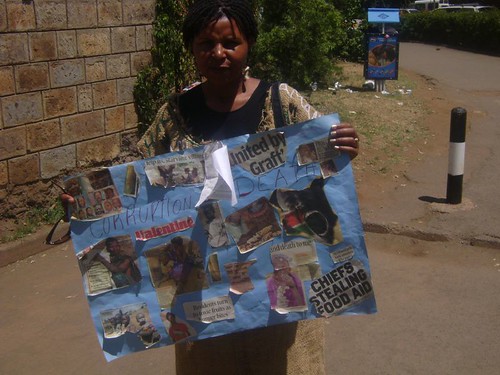
10 million cuttings for 10 million Kenyans: A Valentine Story.

By Philo Ikonya

I stepped out wearing my sackcloth and many cuttings of the starving people of Kenya that have been coming in our main three newspapers in one brown envelope. It's Valentines Day so I will also drape a red sash and speak to the ladies in red without alienating them and ask them and the men in town to remember to make a donation to the dying.

I cut out faces of children, old women lying down, old men with long rib cages seated stooping forward with all their flesh turned into little sacks of skin sagging down to their loins. Life petering out in this Kenyan famine of 2009 in Baringo, Ukambani, Pokot. Three dry provinces but also in the dry zones of our more fertile areas such as Ndeiya in Limuru.

And yes, I found her too. The woman my friends and I had called the ‘face of famine.' She demonstrated the plight of this hunger so well as she lay out there in Pokot land; rising and falling with her bony frame with eyes already wide open with pain and long limbs devoid of flesh, a shrill voice, that told of pain. She hit the headlines for a few weeks and then stopped. Is she still alive? The media had explained that maize had been transported past this woman and many like her - to Sudan passing by a road a few kilometers from where she lived.

The stories were heartrending telling of how mothers fed their children on wild berries that kept them from going to the toilet often so that their tummies would hold. Mothers asking their teenage daughters to sleep with truck drivers (this is a live wire of the HIV/virus) to get a meal for the family for the day.

I cut out photos too of our politicians. The famine is artificially created by graft in the country and yet, the president sat with guests from the Diplomatic Corp and others in a sumptuous breakfast one morning to proclaim that 10 million Kenyans were faced with starvation and death. An emergency; he declared. And some 35 billion Kenya Shillings were needed. The good people responded to the appeal with some money. Kenyans too quickly organized interventions such as collection points for maize flour despite the shooting food prizes that other governments in the world were trying to mitigate. Here Kenyans had been arrested before the famine for sounding the alarm that the prices were skyrocketing and that people in Nairobi slums and other places were living on Ugali (maize meal) and salt instead of vegetables and meat. I cut out their fat and oily faces… and their disagreements on many fronts the latest having been the failure to establish a Tribunal to investigate political violence.

I also cut out faces of ordinary Kenyans struggling and winning in athletics, masses of people under the banner of People Power. These I put in my victory envelope. There were great things to celebrate here and our failures in politics are the exception to the rule in Kenya’s other actions. This is what we have to win. The battle of getting every Kenyan to redeem their vote from association with war and bloodshed and then to vote without considering tribe but looking for change.

Cut out of course, were the scandals that hit the headlines. The stolen and imported maize involving not just the agriculture ministry but also a cross section of our very well paid MPs. I cut out maize stems looking good and full. Kenya never lacks maize because of the rain. And the fuel scandal expressed with a pump over stacks of bank notes. Stolen too.

As I set out with all these cuttings to buy manila paper and glue and stick them and use them not only to discuss generosity in donations but also the Change our country must allow or fall again, the song; Someone is dying Lord Kumbaya,” came to mind. I remembered the last time we sang it, this time last year, Kenya was on fire.

In the first spot I stopped, someone tapped my shoulder and asked me if she had seen me speaking somewhere. I told her yes, and there was a flow of compliments… I had just been wondering what the town mood would be like when as she introduced herself, I looked into her face and we said it together: "Terry Kariuki. The Late Josiah Mwangi Kariuki’s widow. JM."

She stood there looking into my eyes and telling me how voices were important. I felt my skin creep and tears came to my eyes as she spoke of what happened to her vocal and popular husband who was so angry about greed in Kenya. He spoke very strongly for the poor and suggested well thought out policies in Parliament. He was assassinated on March 2nd 1975. Terry and I parted on the note of how much work remained to be done. I did not lose a chance to speak to people and to tell them to speak to others about our country, and the hope we have for new political leadership.

Here was a lady, clad in wonderful clothes, an expensive coat and shoes, she held a wonderful bouquet of roses. The flowers were set beautifully and the flower pot covered with love hearts and a cellophane paper for their protection made a soft swish sound. Angela about 4ft8, looked great, her dark skin beamed delight, a strong and confident woman, after a compliment on the love those flowers told, she spoke to me in the Nakumatt Lifestyle corridor as if we had an appointment. Tears came to her eyes, and I had not yet even put up the pictures on my poster, as she listened to why I was on the streets that day. She was moved to act and she said she would support our cause and left her contact. She understood how important it was for her to get many others in her social milieu to think of change. Later I would weave between wealthy looking men buying flowers, why even some big shots and a reminder of the unga touched them with one I once worked with even hugging me. But in all conversations, it was clear, the middle and upper class are anxious.

At Jeevanjee gardens, a Bunge la Mwananchi session was on. It was about change in leadership. I made my contribution and also talked about flour- the Wabunge were already organized and had a book of goods collected for the poor. I made my contribution as Mumbi and Nduta, two sisters present went to a bench with me to stick the cuttings to the manilla paper.

The theme: Corruption = Death.

As we were about to finish, we noticed the return of a big police vehicle (we had been told it had been driven from there earlier and thought we were safe) and we left the garden as they reversed in. I was doing a solo thing because groups of Kenyans on the streets talking change are often arrested. I have one court case for singing about freedom and that is enough.

Joined by another activist and the two girls we set off carrying our graphic poster. A pair of sisters were eager to know what this was all about and explaining to them, they gave thanks and promised to spread the message: Support the dying today, vote in new leaders tomorrow.

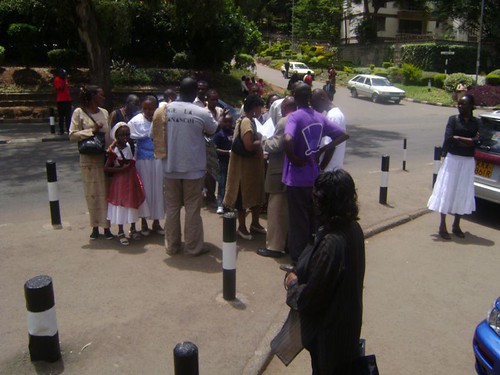
Two seconds into Tuskys supermarket and a former classmate bought flour for contribution, a woman alone with her little one also paid up for more and I bought 20 kilos. Our kitty had started to swell. With the receipt stapled onto the poster we could now stand outside the supermarket and urge others to make a contribution. We paced the Muindi Mbingu Street and in the end we had spoken to about 300 people. They kept coming out to listen to us in little constant groups of between 15 and 30. It was at this point when I looked up and saw activist George Nyongesa in the crowd. He took to this so heartily and when we finished, he asked me to go with him on the following day outside some churches. He told me he believed now change can only come to Kenya if we speak to people one by one with the zeal of missionaries. It was not going to come through organizations. We have started to move.

We have just come from four more hours of activity and we estimate about 500+ people listened and some spoke to three of us, activist Kamotho having joined us. Many said they had given up on their vote but now they would go out and tell others there is hope. Others gave their addresses urging us to stay in touch with them. Many were raging with the desire for change and saying they only wish we could all meet.

You see, on one side of the banner we had a victory message with someone lifting a trophy out of a mammoth crowd with the heading: People Power. Here, hope and victory were discussed and we shared that we would not believe in hopelessness ever but that we would do our best, especially as Christians- most of the people were going to three churches in the area- to move our country ahead. All the people we spoke to were encouraged to speak to many more and to keep doing it. They could not hide their happiness and some of them thanked us profoundly ( even prayed and blessed us) as we thanked them for the work they had prepared to do by stopping to share – just for a few minutes.


It is impossible to forget the faces of the poor men who listened so keenly and spoke of the pain they bear in their hearts and the faces of rich and happy girls. And Terry Kariuki’s? Her look and words will remain etched and recorded somewhere no camera or TV can reach. Her sparkling and searching eyes with a smile of life turned pain will not go away. Will what her husband and: Mboya, Ouko, Bishop Muge died for, one day be achieved? JM is the man who said Kenya will become a country of 10 billionaires surrounded by beggars.

Today, 10 million die, they are not just food insecure- that is a polite name for death.

Sunday, November 21, 2010

Bjornson, its time to speak to us! U inspire!


What I like about Bjornson is that he is a silent giant that is awakening. He was one of the four giants of Norwegian Literature along with Ibsen, Kiellands and Lie. Ibsen got the best attention.

I am inspired by Bjornson in many ways!

Being great and silent but talking at the right time.
Making us question what is the meaning of relevance!

Being a political activist.. although I prefer people who vote
I love it that Ibsen said to him that his own life.. Bjornson 's is literature.

Influencing politics deeply without being in Parliament or in Government.
Encouraging Norwegians to use their own language and not Danish.

Making an artistic contribution to the Norwegian National Anthem in his own words.
Making royalty in Norway have to discover how to fly a flag at half mast at his death.

Being relevant to me today.


Now that his centenary is being celebrated in Norway, I found a corner in his honour and took this photo. The photo is great but the sad thing is that the friend who took it is in hiding. Her brother disappeared in Pakistan, a rather common story and she suffers so much wondering if she will ever see him. She was outspoken and ended up in refuge. But the dead also speak and all governments should learn to respect freedom and justice!

Saturday, November 20, 2010

Leading the Night

This novel by Philo Ikonya, Leading the night, is almost out. The cover is not loading here.. but with time it will. Philo is excited!

http://docs.google.com/viewer?a=v&pid=gmail&attid=0.1&thid=12c4fc43ca3a9278&mt=application/pdf&url=http://mail.google.com/mail/?ui%3D2%26ik%3D6815fab758%26view%3Datt%26th%3D12c4fc43ca3a9278%26attid%3D0.1%26disp%3Dattd%26realattid%3Df_ggjdw59l0%26zw&sig=AHIEtbQMcgbIaOZtY8emQ3jPFB45mrmKXA

2017, Kenya post- election deadlock is old; who did not see it coming did not want to, and the child is dead

       Mathare Math in voice...for Raila Odinga     His mouth is open with fear. The palms of his hands with fingers open. This is a fla...